
Brand Strategy
6 min
How premium design changes perceived value before a client reads your offer
The visible layer of your brand sets pricing expectations faster than any sales …
Read article

Design is not just aesthetics — it directly impacts revenue. Here's the real cost of cheap design and what premium UI/UX actually does for your conversion rate.
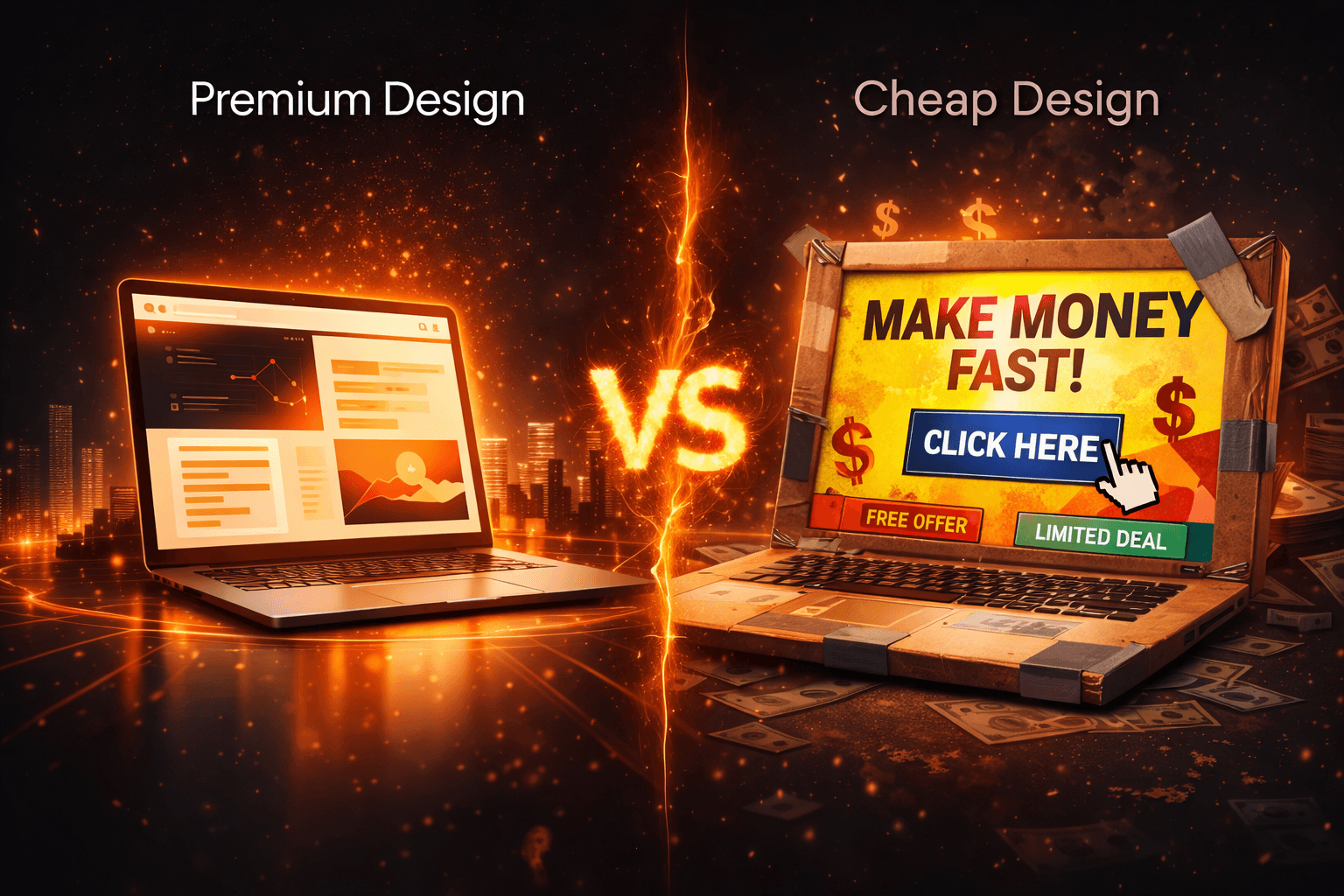
Design is not just aesthetics — it directly impacts revenue. The quality of your visual design shapes how potential clients perceive your business before they've read a single word, and that perception determines whether they stay, trust, and convert.
Low-quality design leads to low trust, low conversions, and weak positioning. Even if your product or service is genuinely excellent, perception kills deals before they start. Potential clients don't know how good your work is yet — they can only see how your brand looks. And if it looks cheap, their brain files you in the "budget" category before any conversation has happened.
The irony of cheap design is that it costs more in the long run. You save on the upfront design investment and pay for it indefinitely in lower conversion rates, weaker pricing power, and clients who choose competitors based on appearance alone.
High-end UI/UX design communicates professionalism, expertise, and confidence — before a word is read. Users make trust decisions in the first three seconds of landing on a page. A well-crafted visual hierarchy, intentional typography, controlled whitespace, and a coherent colour system all signal that the people behind this brand know what they're doing.
This is the authority transfer. When your design looks like the brands your clients already trust, some of that trust transfers to you by association. Premium design doesn't just make you look better — it positions you in the right competitive category.
Good design guides attention, reduces friction, and builds trust — and each of these directly increases leads, sales, and engagement. A clear visual hierarchy tells visitors where to look. A friction-free user experience removes the hesitation that kills conversions. Trust signals — testimonials, results, consistent branding — presented with design precision carry more weight than the same information in a poorly designed layout.
This isn't subjective. Conversion rate optimisation studies consistently show that design changes — button placement, colour contrast, whitespace, typography hierarchy — have measurable, significant impact on the percentage of visitors who take action.
UI/UX design is not decoration. It is a system that directly affects user behaviour, retention, and revenue. Every design decision — from the placement of a CTA button to the weight of a headline — is either helping or hurting your conversion rate. There is no neutral design.
The businesses that treat design as a strategic business tool, not a cosmetic layer, consistently outperform those that treat it as an afterthought. They attract better clients, charge higher prices, and convert more consistently — not because their service is better, but because their presentation signals that it is.
If your design looks cheap, your brand feels cheap. And if your brand feels cheap, your pricing will be challenged, your conversions will suffer, and your best potential clients will choose someone else.
Premium design is not vanity spending. It is the most visible investment you can make in your business's commercial performance.
Free 15-minute call. No commitment. Honest advice on what would move the needle for your business.
The visible layer of your brand sets pricing expectations faster than any sales …

Branding is not just a logo — it's the perception your business creates before a…
A beautiful homepage still underperforms if visitors can't instantly understand …
Free call, no commitment. We'll tell you exactly what would move the needle for your brand.