Brand Strategy
6 min
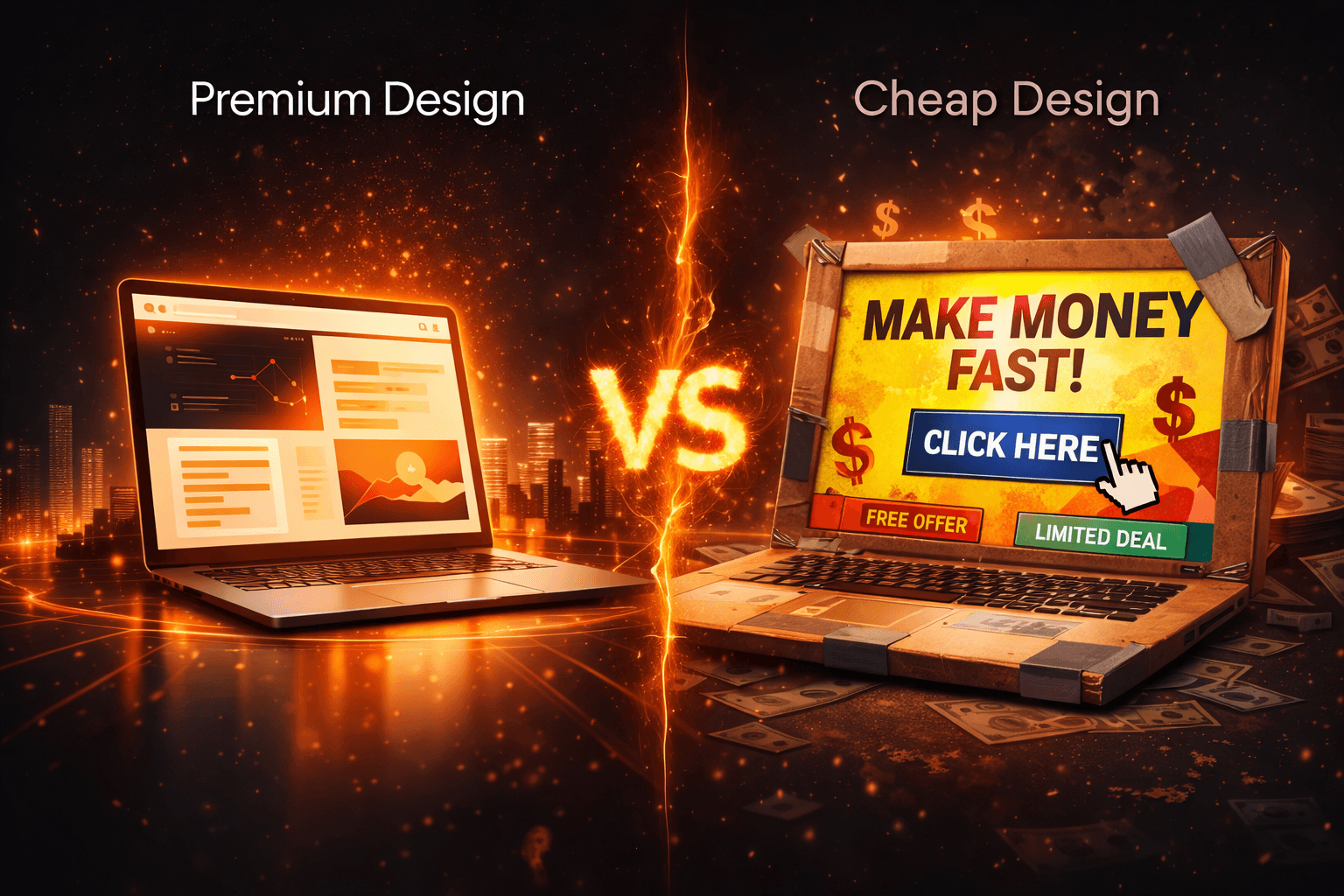
Premium Design vs Cheap Design: What Actually Converts?
Design is not just aesthetics — it directly impacts revenue. Here's the real cos…
Read article

The visible layer of your brand sets pricing expectations faster than any sales deck ever will. Here's the psychology behind it — and how to use it.

There's a moment that happens in the first three seconds of someone landing on your website, opening your proposal or picking up your business card. Before they've read a word, before they've processed your offer, before they've consciously thought anything at all — their brain has already formed a price expectation.
This isn't a theory. It's measurable, predictable and almost entirely within your control.
Every design decision you make — typeface choice, colour temperature, whitespace density, image quality, border radius, shadow depth — communicates something about where you sit on the value spectrum. Collectively, these signals tell your audience what bracket to put you in before they evaluate anything else.
A clinic using Comic Sans and stock photos doesn't just look cheap. It actively undermines trust in the quality of the service itself. Conversely, a freelance consultant with a thoughtfully designed brand often gets quoted higher rates — not because the work is different, but because the perceived category is different.
The signals that most reliably communicate premium positioning are: high contrast without being harsh, intentional use of whitespace, restrained typography (fewer typefaces, more hierarchy), photography that feels specific rather than generic, and a colour palette with purpose rather than personality.
Here's what makes this particularly powerful for businesses: premium visual design doesn't just make you look good. It anchors the price expectation at a higher point, which means when your actual price is revealed, it's evaluated against that anchor rather than against competitors.
A prospect who has experienced your brand as premium will price-compare you against other premium options, not against the cheapest provider in the market. You've shifted the competitive frame entirely — just through design.
We saw this clearly with Nomia K&B: after a full visual redesign, the quality of inquiries improved significantly before a single word of copy changed. Prospects were arriving pre-convinced of the positioning. The design did the pre-selling.
Typography: Are you using system fonts or generic Google fonts that every competitor also uses? A distinctive typeface — used consistently — creates immediate differentiation. Syne, Editorial New, GT Alpina, Neue Haas Grotesk — these carry weight before they're read.
Whitespace: Overcrowded design signals either amateur execution or panic — the feeling that you have to justify your price by listing everything. Premium brands use space to signal confidence. Less visible = more implied.
Photography: Generic stock is instantly recognizable and immediately deflating. Even mediocre original photography outperforms perfect stock because it signals authenticity. If budget is limited, focus on one outstanding hero image rather than a gallery of average ones.
Consistency: Premium brands look the same everywhere. Instagram matches the website matches the business card matches the email signature. Inconsistency signals that no one is in control of the brand — which implies no one is fully in control of the business.
Design is a lever, not a solution. Premium visual positioning sets a higher price expectation — but if the actual product or service doesn't deliver, the gap between expectation and reality accelerates churn and destroys trust faster than no design at all.
The goal isn't to look more expensive than you are. It's to look as good as the service you actually deliver — and to stop underselling yourself through a visual identity that doesn't reflect the real quality of your work.
Free 15-minute call. No commitment. Honest advice on what would move the needle for your business.
Design is not just aesthetics — it directly impacts revenue. Here's the real cos…

Branding is not just a logo — it's the perception your business creates before a…

A beautiful homepage still underperforms if visitors can't instantly understand …
Free call, no commitment. We'll tell you exactly what would move the needle for your brand.